

Board & Governance
AI Cost Isn’t an IT Issue — It’s a Board Issue
AI Was Cheap While We Learned to Depend on It. Boards Should Prepare for What Comes Next.
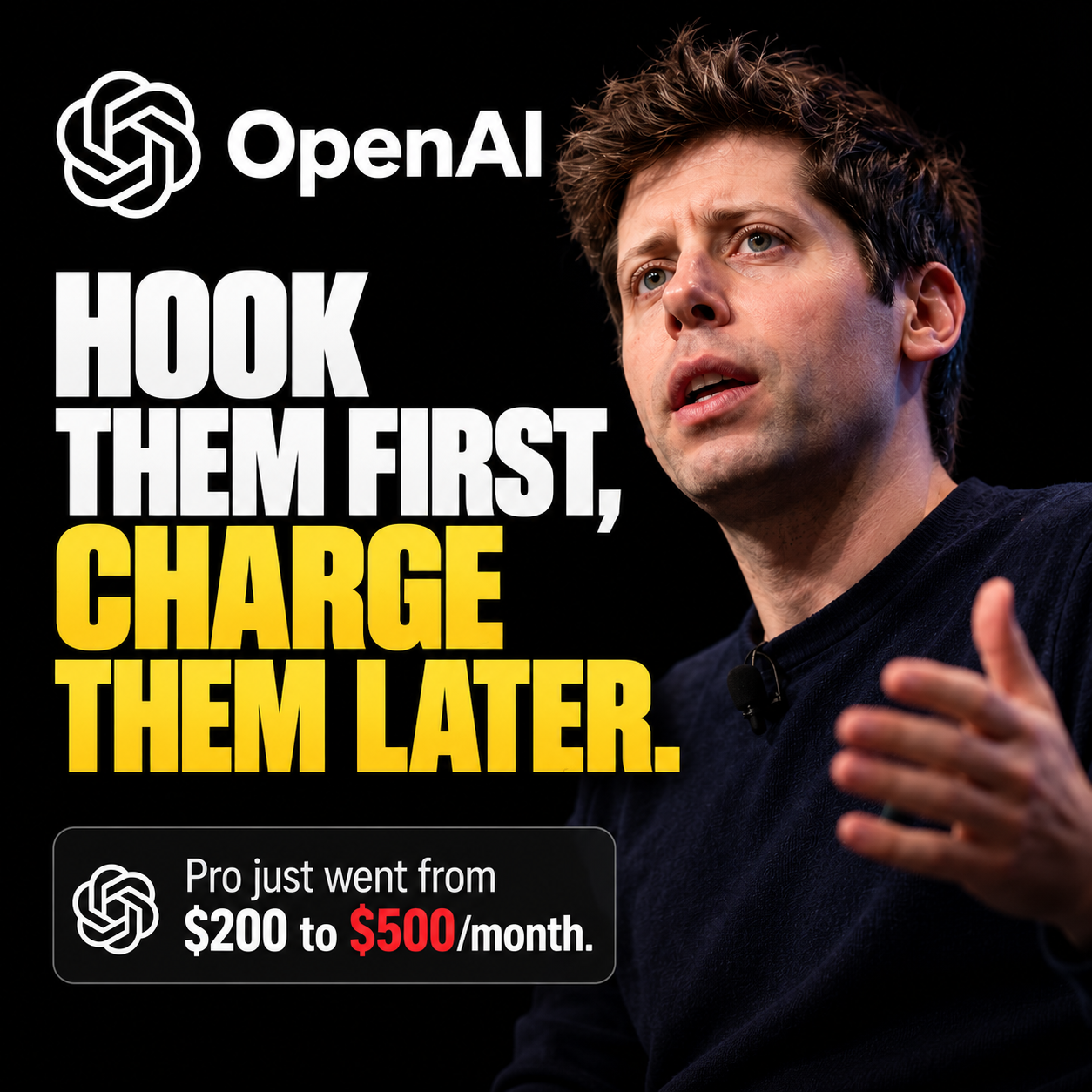
OpenAI’s new $500 Pro tier is more than a pricing story. It is an early warning for boards about the economics of AI dependency.
A year ago, I wrote several times that AI could follow what I call the Uber model:
Get us hooked first. Increase the price later.
That is increasingly what we are seeing.
OpenAI has introduced a new Pro 500 plan at $500 per month. Technically, its $200 Pro tier remains. But the economics of that tier have changed: OpenAI is reducing included usage for Pro 200, while its new $500 tier offers its highest usage allowance and exclusive access to its fastest “Ultrafast” capability. Reporting indicates that included Work and Codex usage on Pro 200 is being cut from 20× to 10× the Plus allowance.
So for a heavy user who wants the highest level of capability, this looks very much like an effective move from $200 toward $500 per month.
And I don’t think $500 is the interesting number.
The interesting question is:
What happens to the economics once companies cannot operate without AI?
From adoption to monetization
Uber didn’t initially need every ride to demonstrate mature economics. It needed to change behavior.
Once consumers reorganized part of their lives around ride-hailing, the product became much harder to give up.
AI is potentially following an even more powerful version of that playbook.
We are embedding it into software development, research, customer service, sales, marketing, analysis, administration and increasingly decision-making itself.
The next generation of AI agents goes further still. OpenAI’s newly announced agents are designed to work autonomously across applications rather than simply respond to individual prompts.
The early battle was therefore about adoption.
The next one is about monetization.
There is also a fundamental economic reason this matters. AI isn’t conventional SaaS with a near-zero marginal cost for another user performing another task. Reasoning, coding and autonomous work consume compute.
The more work we delegate to AI, the more compute we consume.
So I believe boards should work from a prudent assumption:
AI can make the enterprise dramatically more productive while simultaneously becoming substantially more expensive.
Those two things are not contradictory.
AI economics belongs in the boardroom
If AI remains a handful of productivity tools, pricing is largely a procurement issue.
If AI becomes embedded in how the company operates, it becomes a strategic dependency.
That changes the board conversation.
As a NED and investor, there are five things I would want management teams to start doing now.
1. Measure AI ROI by workflow.
“AI saved us time” isn’t enough.
Which workflow changed? What did it cost before? What does it cost now? Did AI reduce headcount requirements, increase capacity, shorten cycle time, improve conversion, accelerate product development or generate incremental revenue?
Boards need to understand where the economic value is actually being created.
2. Stress-test AI economics.
Don’t build a business case assuming today’s pricing remains today’s pricing.
Model what happens if the cost of an important AI workflow increases 2× or 5×.
Then model the other side of the equation: what happens if adoption succeeds and AI usage increases tenfold?
A company can negotiate a good unit price and still end up with a much larger bill because AI becomes embedded everywhere.
3. Understand vendor concentration.
Management should be able to tell the board which business-critical processes depend on OpenAI, Anthropic, Microsoft, Google or another provider.
Then ask:
What happens if pricing changes?
What happens if usage limits change?
Can we switch models?
How long would migration take?
What data, integrations and workflows make us difficult to move?
The deeper AI becomes embedded in an organization, the more consequential those questions become.
4. Don’t build tomorrow’s operating model around today’s AI price.
This may be the most important lesson.
A workflow can look extraordinarily attractive while AI is inexpensive and adoption is being aggressively encouraged.
But boards approve investments based on future economics, not promotional economics.
Before reorganizing teams or eliminating capabilities because AI can perform the work more cheaply today, management should demonstrate that the model remains viable under materially different pricing assumptions.
5. Put AI economics on the board dashboard.
Boards increasingly discuss AI risk.
They should also be discussing AI unit economics.
I would want a concise view of:
AI spend → usage → measurable value → ROI → vendor concentration → critical dependencies.
Not another 40-page AI strategy presentation.
A small number of numbers that tell directors whether AI is creating enterprise value—and how exposed the company is if the economics change.
The strategic question isn’t whether to use AI
I am not arguing that companies should slow AI adoption.
Quite the opposite.
The productivity opportunity is enormous, and organizations that fail to adapt may find themselves structurally disadvantaged.
But there is an important difference between using AI and building a company that economically depends on AI.
The latter requires board-level scrutiny.
Uber subsidized the ride until we changed how we moved.
AI has been extraordinarily inexpensive while we changed how we work.
OpenAI’s $500 tier doesn’t prove that AI prices will inevitably rise. Competition, cheaper models and falling inference costs could push some prices in the opposite direction. But it does demonstrate something boards should already understand: today’s AI pricing and usage allowances are not permanent assumptions on which to build a five-year operating model.
My expectation is that the economics will continue to evolve—and that the most valuable AI capabilities will command significant prices as our dependence on them increases.
Boards don’t need to predict exactly what AI will cost.
They need to make sure their companies can withstand being wrong.
A board conversation worth having
If your organization is embedding AI into core workflows, I work with founders, CEOs, investors and boards to pressure-test AI economics, strategic dependencies, governance and operating models.
A focused strategy session can examine where AI is genuinely creating value, where concentration risk is emerging, and whether the economics still work under materially different cost and usage assumptions.
Book a Strategy Call with The Scale Foundry.
Smarter growth. Stronger leadership. Real results.